You have scrolled through hundreds of gorgeous homes on Instagram. You’ve saved enough Pinterest boards to wallpaper your entire house. And yet, when you look around your own living room, something still feels off. The couch is fine, the walls have paint on them, and there are things on the shelves, but it just doesn’t feel pulled together.
Here the truth professional interior design don’t use some secret magic. They follow a set of learnable, repeatable principles that anyone can pick up. You don’t need a design degree or a six-figure budget to make your home look stunning.
Start by Finding Your Personal Design Style
Before you spend a single dollar on décor, figure out what you actually like. Most people skip this step, and that’s exactly why their homes end up looking random.
Interior designer Grant K. Gibson suggests a brilliant trick look at your closet. Your everyday clothing tells you whether you lean toward bold colors or quiet neutrals, structured pieces or relaxed fabrics. What you wear often mirrors what you want in a room.
Open Pinterest and start pinning 30 to 40 rooms that catch your eye. Don’t filter yourself. After a while, you’ll notice patterns maybe warm wood tones keep showing up, or deep greens, or rooms flooded with natural light. That’s your aesthetic trying to tell you something.
Also think about real spaces you’ve loved. A cozy restaurant. A boutique hotel room. A friend’s kitchen where everyone always ends up gathering. What made those places feel so good? Was it the lighting, the colors, or the way everything felt relaxed but intentional? Those gut feelings are your most reliable design guide.
Declutter Before You Decorate
You can’t style a room that’s drowning in stuff. Think of it this way it’s like trying to put on makeup without washing your face first. The good stuff can’t shine through the mess.
Professional stylists always begin by clearing everything out and then building the room back up with intention. Pull everything off your coffee table, shelves, and countertops. Box it all up if you have to. Then only bring back items you genuinely love or that serve a real purpose.
A single beautiful vase on a shelf makes a statement. That same vase surrounded by junk mail and random candles? Just visual noise.
Your best tools for keeping things clutter-free:
- Baskets and woven bins for hiding everyday items
- Cabinets with doors instead of open shelving in busy areas
- Drawer organizers to keep small items from spilling onto surfaces
- A “one in, one out” rule to stop things from piling up again
Master the 60-30-10 Color Rule
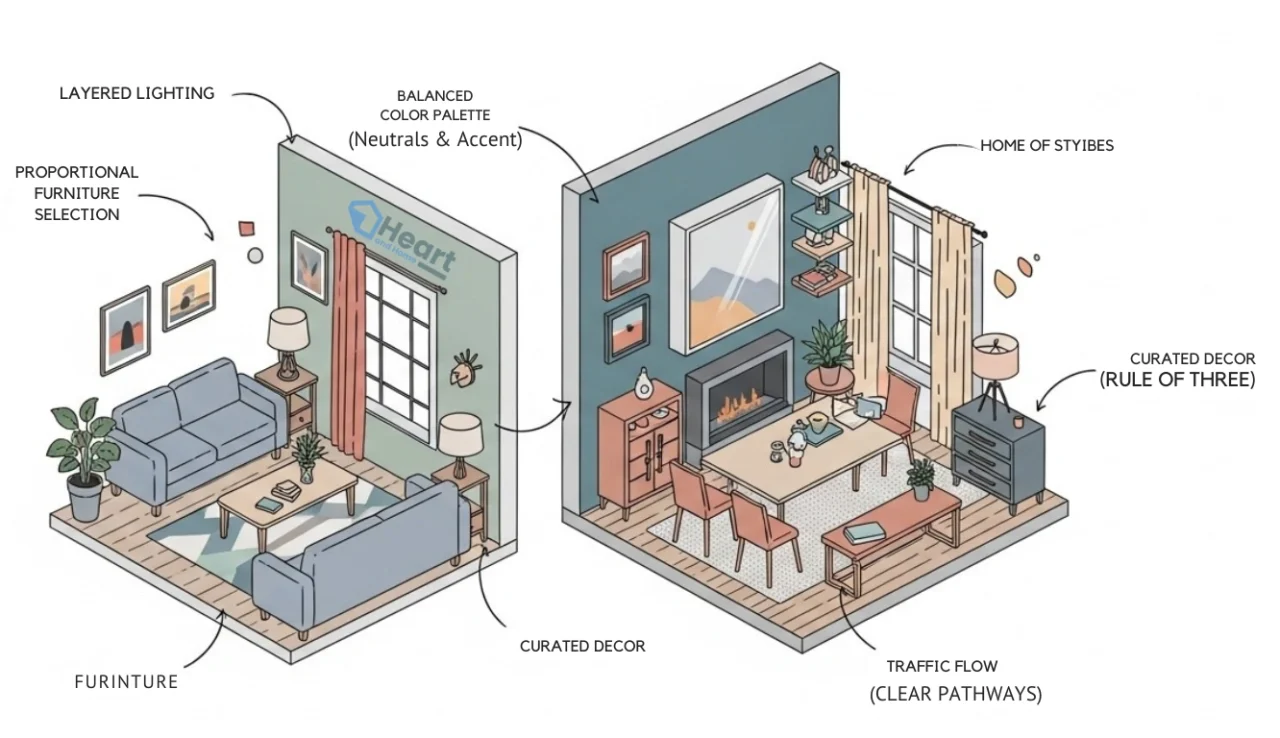
Color can make or break a room. The formula professionals swear by is the 60-30-10 rule, and it works every single time.
Sixty percent of your room should use a dominant color usually a neutral on walls and large furniture. Thirty percent goes to a secondary color in curtains, accent chairs, and bedding. The remaining ten percent is a bold accent that shows up in pillows, artwork, and small decor pieces.
This ratio gives the eye somewhere to rest, a layer of interest, and those exciting little pops of surprise all without feeling messy. Right now, earth tones like terracotta, chocolate brown, and warm cream are dominating the design world, paired with jewel accents like deep emerald and plum.
| Color Category: | Percentage: | Where It Shows Up: | Examples: |
|---|---|---|---|
| Dominant Color | 60% | Walls, large furniture, rugs | Warm cream, soft taupe, light gray |
| Secondary Color | 30% | Curtains, accent chairs, bedding | Olive green, warm clay, slate blue |
| Accent Color | 10% | Pillows, art, decorative objects | Deep emerald, burnt orange, gold |
Layer Textures Like a Designer
If one thing separates a professionally styled home from an amateur one, it’s texture. Color gets all the attention, but texture is what actually makes a room feel alive.
A room full of smooth, hard surfaces feels cold. Too many soft surfaces and it feels heavy. The magic happens when you mix opposites a sleek leather chair with a chunky knit throw, a polished floor with a plush rug, a glossy vase sitting on a rough wooden shelf.
Most designers aim for five to seven textures in every room:
- Wood flooring or furniture for warmth
- Linen or cotton upholstery for softness
- Velvet or boucle throw pillows for richness
- Woven baskets or rattan for organic appeal
- Ceramic or glass accessories for polish
- Metal frames or hardware for a bit of edge
- Wool or jute rugs for grounding the space
Keep your color palette tight while playing freely with textures. And when you’re buying fabrics, check the “double rubs” rating on the description. It measures how durable the fabric is the higher the number, the longer your sofa or chair will hold up.
Invest in Quality Over Quantity
Here’s a lesson most people learn the hard way that bargain sofa you grabbed on impulse will look tired and saggy within two years. Professional designers treat furniture as an investment, not a quick purchase. One beautifully made sofa will always outshine five cheap pieces.
The smart move is knowing where to put your money and where to hold back.
Where to invest:
- Your sofa — you sit on it every single day
- Your mattress and bed frame — you spend a third of your life here
- Your dining table — the place where everyone gathers
- Main lighting fixtures — they control the entire mood of a room
Where to save:
- Throw pillows and blankets — swap them out seasonally
- Small decorative accessories — candles, trays, vases
- Accent furniture — side tables, stools, small shelves
- Seasonal decor — things you’ll rotate throughout the year
If you have an awkward space, consider having something custom-made. A built-in bookshelf or a sofa tailored to fit an odd alcove looks far more intentional than a random off-the-shelf piece shoved into a corner.
Get Your Lighting Right
Lighting is hands down the most underestimated element in home design. Most people just flip on the overhead light and call it done, but that flat illumination is exactly why their rooms feel lifeless.
Designers work with three layers of lighting at once. Ambient lighting fills the room through ceiling fixtures. Task lighting focuses on activities like reading or cooking. Accent lighting adds drama by highlighting artwork or interesting architectural details.
Quick lighting upgrades that make a noticeable difference right away:
- Swap cool-toned bulbs for warm ones in the 2700K to 3000K range
- Add table lamps to rooms that only have overhead lights
- Put dimmer switches on your main ceiling lights
- Place a floor lamp in every dark corner
- Hang sheer curtains and lay light-toned rugs to bounce natural daylight around
A room that uses all three layers feels warmer, deeper, and far more inviting than one depending on a single overhead fixture.
Create a Focal Point in Every Room
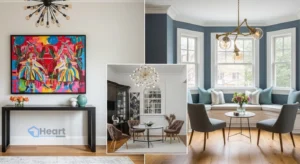
Walk into any beautifully styled space and your eye lands somewhere specific. That’s no accident it’s a focal point, and every room needs one.
Your focal point could be a fireplace, a large painting, a standout piece of furniture, or a gorgeous window with a view. Everything else in the room should support it, not fight with it. If your room doesn’t have a natural focal point, make one. Hang an oversized piece of art, paint one wall a deeper color, or position a bold piece of furniture where the eye goes first when you walk in.
Focal point mistakes you want to avoid:
- Having too many competing centerpieces in one room
- Putting the focal piece against the least visible wall
- Forgetting to light the focal area properly
- Surrounding it with equally bold items that steal the attention
One strong anchor per room. That’s the rule. Everything else plays a supporting role.
Understand Scale, Proportion and the Rule of Thirds
Ever walked into a room and felt something was off without knowing why? Most of the time, the furniture is the wrong size for the space.
Big pieces crammed into a small room feel suffocating. Tiny furniture in a large room feels empty and awkward. Before you buy anything, grab some painter’s tape and outline the item’s dimensions on your floor. This one trick alone saves you from countless expensive mistakes.
Designers also rely on the “rule of thirds” for arranging things. Picture a tic-tac-toe grid over your room and place key furniture at the intersections, not dead center. This creates a layout that feels natural and interesting instead of stiff and predictable. In bigger rooms, try creating separate zones a conversation area, a reading spot, a workspace rather than shoving everything against the walls.
Mix Old and New, High and Low
Here’s something you’ll spot in every professionally styled home nothing matches perfectly. And that’s completely on purpose.
Buying a matching furniture set from one store is the fastest way to make your home look like a catalog page. Instead, mix eras, styles, and price points. Put a modern sofa next to a vintage side table. Layer an affordable rug under a high-end lamp. Set a family heirloom beside something you found at a flea market last weekend.
Rules designers follow when mixing styles:
- Put at least one vintage or antique piece in every sightline.
- Combine curved furniture with angular pieces for contrast.
- Mix at least two different wood tones in a room to add depth.
- Don’t buy everything in the same week let your collection grow naturally.
- Connect different styles through a shared color palette so nothing feels random.
This approach adds real depth and tells a story. Your home should feel like you put it together over time with thought and care, not like you ordered everything in one cart.
Bring in Greenery and Plants
Here’s something most home styling guides barely mention plants are one of the most powerful design tools out there, and they cost almost nothing compared to furniture or art.
Every professionally designed space has greenery in it. Hotels, magazine shoots, beautiful restaurants they all use plants because nothing else adds color, texture, organic shape, and a feeling of life all at the same time.
The trick is treating plants as a real part of your design instead of randomly sticking a pot on the windowsill.
How designers use plants with purpose:
- Fill empty corners with tall floor plants like fiddle leaf figs or birds of paradise
- Drape trailing plants like pothos across bookshelves for movement and softness
- Group plants in clusters of three or five at different heights
- Match planters to your room’s style ceramic for modern, woven baskets for boho, metal for industrial
- Use plants to soften hard angles and awkward architectural spots
If you struggle to keep things alive, start with forgiving varieties like snake plants, ZZ plants, pothos, or succulents. They handle low light and missed waterings like champs. And honestly, high-quality faux plants work just fine in dark spaces where nothing real would survive anyway.
Style Your Windows Like a Pro
Window treatments are one of the biggest giveaways that a room hasn’t had professional attention. Bare windows or leftover builder-grade blinds instantly cheapen an otherwise beautiful space.
Designers use one universal trick hang curtain rods as close to the ceiling as possible, not right above the window frame. This pulls the eye upward and makes your walls look much taller than they actually are. Let your curtains just barely touch the floor, or puddle slightly for a more luxurious feel.
Choosing the right window treatment for each room:
- Living rooms and bedrooms: Floor-length curtains in linen or velvet for softness and height
- Kitchens and bathrooms: Roman shades or woven bamboo blinds for easy light control
- Home offices: Sheer curtains that filter light without blocking it
- Formal dining rooms: Heavier drapes in rich fabrics for warmth and drama
- For maximum flexibility: Layer sheer inner curtains with heavier outer drapes
The right window treatment adds texture, warmth, and proportion that bare windows simply can’t match.
Use Mirrors Strategically
Mirrors do far more than let you check your reflection. Designers use them as styling tools, especially in tight or dim spaces. They bounce light around, create the feeling of more room, and double as decorative pieces.
One common mistake hanging a mirror straight across from a window, which just sends the light right back outside. Hang mirrors perpendicular to your windows instead so the light spreads deeper into the room. In dark hallways or small entryways, one oversized mirror can make the whole area feel twice its actual size.
| Design Principle: | Common Mistake: | Professional Approach: |
|---|---|---|
| Color Selection | Too many unrelated colors fighting each other | Following the 60-30-10 rule for balance |
| Furniture Scale | Pieces too large or too small for the room | Taping dimensions on the floor before buying |
| Lighting | Only using the overhead light | Layering ambient, task, and accent lighting |
| Texture | Every surface feels the same | Mixing 5 to 7 different textures for depth |
| Accessories | Every surface covered with objects | Leaving breathing room and editing ruthlessly |
| Style Mixing | Matching furniture sets from one store | Blending vintage, modern, and budget pieces |
| Plants and Greenery | Random pots on windowsills with no thought | Intentional placement at varied heights |
| Window Treatments | Bare windows or builder-grade blinds | Ceiling-hung curtains in purposeful fabrics |
FAQs
What’s the biggest mistake people make when decorating?
Buying everything from one store in one go. It creates a flat, lifeless look. Mix pieces from different places, time periods, and price points so your home feels like it grew over time, not like it arrived in a single delivery.
Do I need to hire an interior designer?
Not at all. The core principles balance, proportion, good lighting, texture, and smart editing are things you can learn and apply yourself. Start with one room, use these techniques, and your eye will sharpen with every project.
How much should I spend on styling a room?
There’s no set number. Great rooms come from intentional spending, not big spending. Put your money into daily-use items like your sofa and lighting. Save on accessories and seasonal pieces you’ll swap out later.
How do I follow trends without redecorating every year?
Build your rooms on timeless bones neutral walls, classic shapes, quality materials. Then bring in trends through pillows, throws, art, and small accessories. You get a fresh look without tearing the whole room apart.
How do I make a small room feel bigger?
Mirrors, properly sized furniture, a lighter color palette, curtains hung at ceiling height, and ruthless decluttering. Small rooms punish excess way more than big rooms do, so every item needs to earn its place.
What’s the fastest thing I can do today to improve a room?
Change the lighting. Swap out harsh cool bulbs for warm ones. Add a table lamp or two. Put a floor lamp in a dark corner. Better light instantly changes how everything in the room looks and feels, and it barely costs anything.
What plants work for people who forget to water them?
Snake plants, pothos, ZZ plants, and succulents are your safest bets. They tolerate low light and irregular watering without drama. Start with one or two and build your confidence from there.
Curtains or blinds which should I pick?
Curtains add softness, height, and a finished look, making them ideal for living rooms and bedrooms. Blinds and shades are more practical in kitchens and bathrooms. A lot of designers use both together for the best of both worlds.
Final Thoughts
Styling your home like a professional isn’t about spending more money or chasing every trend on social media. It comes down to making thoughtful choices picking colors with purpose, layering textures with care, putting your money where it matters, and having the discipline to leave some breathing room. Start with one room, be patient with the process, and trust your instincts. Before long, your home will feel like those magazine spaces you’ve always admired, except this one will actually feel like yours.