Have you ever walked into a home that felt instantly welcoming, somehow both fresh and familiar at the same time. Chances are, you were experiencing the magic of blending modern and traditional styles in interior design. This approach sometimes called transitional design has become one of the most sought-after looks in homes today, and for good reason. It lets you have the best of both worlds the warmth and character of classic pieces alongside the clean simplicity of contemporary design.
Here the thing about decorating sticking rigidly to one era can make your space feel flat, like a museum exhibit or a sterile showroom. But when you thoughtfully combine old and new, you create something with real soul a home that tells your story and evolves with you over time.
Why Mixing Modern and Traditional Styles Actually Works
The Psychology Behind the Blend:
There something deeply satisfying about spaces that honor the past while embracing the present. Interior designer Debbie Mathews puts it beautifully transitional design captures the philosophy that “every room needs at least one antique.” This isn’t just aesthetic preference it’s rooted in how we experience our environments.
When everything in a room comes from the same design era, it can feel oddly one-dimensional. Think about model homes or furniture showroom displays. They might be attractive, but they often lack personality. They feel staged rather than lived-in. By introducing pieces from different periods, you inject character and create visual layers that draw the eye and spark interest.
The post-pandemic world amplified this desire for meaningful spaces. People began craving connections to simpler times and incorporating family heirlooms alongside contemporary pieces became a way to ground themselves during uncertain times. Your grandmother’s antique sideboard next to a sleek modern lamp isn’t just decorating—it’s storytelling.
The Practical Benefits You Might Not Have Considered
Beyond aesthetics, blending styles offers some surprisingly practical advantages:
- Budget-friendly approach – You don’t need to furnish an entire room from expensive designer catalogs when you can mix quality vintage finds with affordable modern basics. That mid-century coffee table you found at an estate sale for fifty dollars suddenly becomes the star of your living room when paired with a contemporary sofa.
- Sustainable choice – Giving new life to older furniture keeps quality pieces out of landfills and reduces the demand for new manufacturing. In an era when environmental consciousness matters, choosing to blend rather than replace feels good on multiple levels.
- Timeless appeal – Mixed spaces age better. Trends come and go, but rooms anchored by a combination of classic and contemporary elements don’t scream “decorated in 2024.” They have a timeless quality that will still feel fresh years down the road.
- Personal expression – Blending allows you to honor family heirlooms while still creating a space that feels current and reflects your individual taste.
Modern vs. Traditional Design Elements
What Defines Traditional Style:
Before you can successfully blend styles, you need to recognize what makes each one distinct. Traditional design draws inspiration from European aesthetics, particularly English and French influences from the 18th and 19th centuries. You’ll recognize it by:
- Ornate detailing and carved woodwork.
- Rich wood tones like mahogany, cherry, and walnut.
- Curved lines and cabriole legs.
- Sumptuous fabrics including velvet, silk, and damask.
- Warm color palettes featuring burgundy, navy, forest green, and gold.
- Architectural details like crown molding, wainscoting, and decorative fireplaces.
The overall feeling is one of established elegance and comfortable formality.
What Defines Modern Style:
Modern design emerged in the early to mid-20th century as a deliberate rejection of ornate traditionalism. It celebrates simplicity, function, and clean geometry. Key characteristics include:
- Straight lines and geometric shapes.
- Minimal ornamentation.
- Open floor plans and uncluttered spaces.
- Materials like glass, steel, concrete, and light woods.
- Neutral color schemes whites, grays, blacks with occasional bold accents.
- Low-profile furniture with sleek silhouettes.
- “Less is more” philosophy throughout.
The atmosphere feels airy, uncluttered, and forward-thinking.
The Sweet Spot: Transitional Style:
When you blend these two approaches thoughtfully, you land in transitional territory a style that’s been steadily gaining popularity and shows no signs of slowing down. Transitional design takes the sophistication and warmth of traditional elements and pairs them with the clean sensibility of modern aesthetics.
The result? Spaces that feel both elegant and approachable, timeless yet current. You might see a room with contemporary gray walls and a minimalist sofa, but the antique mirror above the fireplace and the vintage Persian rug underfoot keep things from feeling cold. That balance is what makes transitional design so universally appealing.
The Golden Rules for Blending Modern and Traditional Styles
Rule One: Let One Style Take the Lead:
Here’s where many people go wrong: they try to achieve a perfect 50/50 split between modern and traditional elements. The result usually feels chaotic rather than curated. Instead, choose one style to dominate say, 70 or 80 percent of the room and let the other play a supporting role.
If you’re working in a Victorian home with period features, lean into traditional as your base and introduce modern elements through lighting, artwork, or accent furniture. Living in a sleek new construction? Start with contemporary foundations and layer in traditional pieces for warmth and character.
Rule Two: Find Your Unifying Thread:
The secret to making disparate pieces look intentional rather than accidental? A common thread that runs throughout the space. This could be:
- A consistent color palette.
- A repeated material (wood tone, metal finish).
- A shared texture.
- Similar scale or proportions.
Color is often the easiest unifying element to implement. Imagine a room where dusky pink appears in both the tiles of a traditional fireplace and the geometric shapes of modern vases. The style contrast remains, but the color connection makes everything feel cohesive.
Create Intentional Contrast:
This might sound contradictory to Rule Two, but stay with me. The magic of blended interiors comes from placing old and new in direct conversation with each other. A distressed farm table becomes infinitely more interesting beneath a sleek contemporary pendant light. An ornate gilded mirror gains fresh relevance when hung above a minimalist console.
These juxtapositions highlight the beauty of each piece by providing contrast. The key is ensuring these pairings feel purposeful. Random mixing creates visual noise; intentional contrast creates visual poetry.
Consider Scale and Proportion:
A massive antique armoire will overwhelm a room full of delicate modern furniture, just as a tiny vintage side table might disappear next to an oversized contemporary sectional. Successful blending requires attention to the physical relationship between pieces.
When mixing styles, try to match the visual weight of items, even if their aesthetics differ completely. A substantial traditional wingback chair can hold its own next to a large modern sofa. A collection of small vintage accessories might need to be grouped together to balance a single bold contemporary artwork.
Room by Room Strategies for Blending Styles
Living Rooms: Where Conversation Happens:
The living room offers perhaps the greatest opportunity for style mixing because it typically contains the most varied furniture. Start with your largest pieces the sofa is usually the foundation. A contemporary sofa with clean lines in a neutral fabric provides a versatile base that can swing traditional or modern depending on its companions.
Key strategies for living rooms:
- Add character through seating variety reupholster that traditional wingback chair in modern fabric
- Choose a coffee table in the opposite style from your dominant seating
- Use lighting as your statement mixing opportunity
- Layer traditional rugs under modern furniture arrangements
- Display collected objects that span different eras
Bedrooms: Balancing Rest and Romance:
Bedrooms benefit from a slightly softer approach to mixing. You want contrast without chaos, interest without overstimulation. The bed typically anchors the space, so consider it your style starting point.
A traditional upholstered headboard with tufting or a carved wooden bedframe brings warmth and romance. Balance it with modern nightstands featuring clean lines, or vice versa—a minimal platform bed gains character when flanked by ornate vintage side tables.
Textile tips for bedrooms:
- A contemporary bed feels inviting when dressed in traditional quilts and quality linens
- Traditional furniture won’t feel stuffy when paired with modern graphic pillows
- Layer different textures to add depth without visual clutter
Kitchens Form Meets Function:
Kitchens present unique blending opportunities because they mix utility with aesthetics. The cabinetry typically sets the dominant tone traditional Shaker-style cabinets with modern hardware updates work beautifully, as do sleek contemporary cabinets paired with an antique hutch for display.
Effective kitchen mixing strategies:
- Use open shelving to display traditional pottery alongside modern geometric vessels
- Consider modern pendants over a traditional island
- Mix metals in hardware and fixtures
- Add warmth through traditional elements like vintage cutting boards or antique pottery
Dining Rooms The Perfect Mixing Laboratory
Dining spaces might be the easiest rooms for style experimentation because the essential pieces are few: table, chairs, lighting, and storage. This simplicity makes bold contrasts especially effective.
Popular approaches include:
- Traditional wooden dining table surrounded by contemporary chairs
- Glass or metal modern table paired with traditional upholstered chairs
- Ornate crystal chandelier over modern dining set
- Contemporary linear pendant above traditional furniture
The 80/20 Rule A Practical Framework
How to Apply This Ratio:
One of the most useful frameworks for blending styles is the 80/20 rule. Dedicate approximately 80 percent of your space to one style and introduce the other through the remaining 20 percent. This isn’t a strict mathematical formula you won’t be measuring square footage but rather a guiding principle.
Your 80 percent usually comes from:
- Architecture and architectural details
- Large furniture pieces
- Overall color scheme
- Flooring choices
The 20 percent typically shows up in:
- Accessories and decorative objects
- Artwork and wall decor
- Lighting fixtures
- Accent furniture pieces
Practical Examples in Action
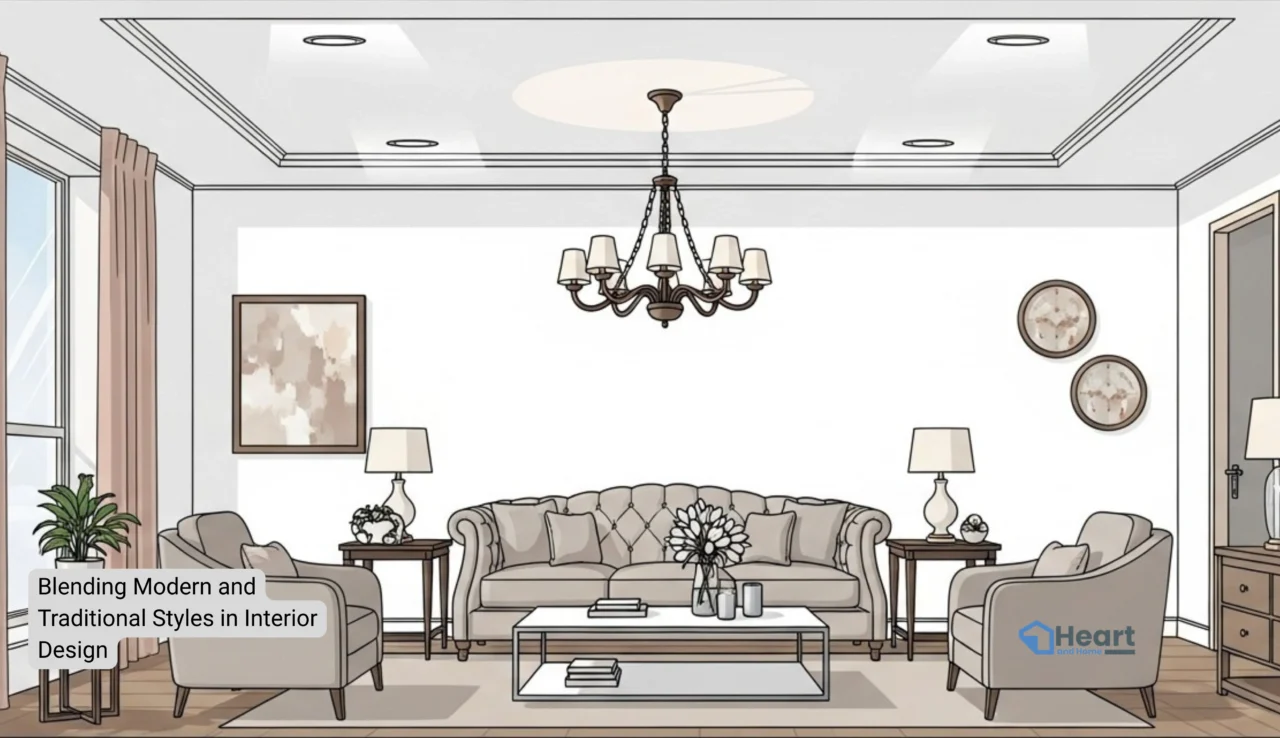
In a traditionally-styled living room (80 percent), your modern 20 percent might include a contemporary coffee table, abstract artwork, and sculptural modern lamp. The room reads as traditional, but those contemporary elements keep it feeling current.
Conversely, a modern open-concept kitchen (80 percent) might gain warmth through traditional touches like vintage cutting boards on display, antique pottery, and a traditional rug runner. The space remains firmly contemporary, but those collected pieces add soul and history.
| Room Element: | Traditional Option: | Modern Option: | Successful Pairing Strategy: |
|---|---|---|---|
| Seating | Rolled-arm sofa, wingback chair, tufted ottoman | Low-profile sectional, Barcelona chair, minimalist bench | Traditional sofa with modern accent chairs, or contemporary seating with vintage side chairs |
| Tables | Carved wood with ornate legs, antique pedestal | Glass top, metal base, geometric shapes | Mix table styles intentionally modern coffee table with traditional side tables works well |
| Lighting | Crystal chandelier, brass sconces, fabric shades | Sculptural pendants, arc lamps, recessed lighting | Vintage chandelier in modern room, contemporary fixtures in traditional space create instant interest |
| Textiles | Damask, floral, velvet, fringe trim | Solid colors, geometric patterns, natural fibers | Layer both modern solid sofa with traditional patterned pillows, or traditional upholstery with geometric throws |
| Wall Decor | Oil paintings, ornate mirrors, vintage photos | Abstract art, simple frames, graphic prints | Traditional frames around modern art, or contemporary gallery wall in traditional room |
| Flooring | Oriental rugs, patterned carpet, dark hardwood | Light wood, polished concrete, simple area rugs | Traditional rug grounds modern furniture; contemporary rug freshens traditional pieces |
Advanced Techniques for the Confident Decorator
The Design Bridge Concept:
Interior designers often speak of “design bridges” elements that inherently merge styles and help disparate pieces communicate. These are your secret weapons for seamless blending.
Examples of design bridges:
- A sofa with classic rolled arms but simplified detailing and contemporary fabric
- A vintage table lacquered in a modern color
- An antique chair reupholstered in geometric fabric
- Traditional architectural details painted in contemporary colors
Strategic Layering for Depth:
Think of your room as having visual layers, like a photograph with foreground, middle ground, and background:
- Background layer: Wall color, moldings, built-ins, flooring
- Middle ground: Large furniture pieces, rugs, major seating
- Foreground: Accessories, artwork, lighting, decorative objects
Varying your style mix across these layers creates depth and prevents flatness. For example: traditional crown molding (background) + contemporary sofa and modern coffee table (middle ground) + vintage accessories and antique lamp (foreground).
The Power of Meaningful Objects:
The most successfully mixed interiors include pieces with personal significance family heirlooms, travel souvenirs, collected treasures. These items transcend style categories and bring authenticity that purely decorative objects can’t match.
Your grandmother’s vintage mirror, regardless of its style, belongs in your home if it matters to you. These meaningful objects form the heart of your design, and the modern living lifestyle or traditional pieces you add around them become supporting players in your personal story.
| Primary Style | Complementary Style | Why It Works | Best Rooms For |
|---|---|---|---|
| Traditional (dominant) | Mid-Century Modern (accent) | Clean MCM lines prevent traditional from feeling stuffy; traditional warmth softens MCM severity | Living rooms, home offices, bedrooms |
| Modern (dominant) | Victorian (accent) | Ornate Victorian pieces become focal points against minimal backdrops; creates sophisticated drama | Dining rooms, entryways, powder rooms |
| Farmhouse (dominant) | Contemporary (accent) | Contemporary elements add polish to rustic warmth; prevents “themed” feeling | Kitchens, family rooms, mudrooms |
| Art Deco (dominant) | Contemporary (accent) | Both styles share geometric influences; contemporary pieces echo Deco’s forward-thinking origins | Dining rooms, bars, master suites |
| Coastal (dominant) | Traditional (accent) | Traditional pieces add gravitas to breezy coastal style; prevents too-casual feeling | Beach homes, sunrooms, guest bedrooms |
| Minimalist (dominant) | Antique (accent) | Selected antiques prevent minimalist coldness; each piece becomes a meaningful focal point | Lofts, studios, small spaces |
Final Thought
Blending modern and traditional styles in interior design is less about following perfect formulas and more about trusting your eye, honoring what you love, and creating spaces that feel authentically yours. The most memorable homes aren’t the ones that rigidly follow a single design rulebook they are the ones that tell a story through carefully collected pieces spanning different eras and styles. Start with one meaningful contrast, build slowly, and watch your space transform into something that’s both timeless and uniquely personal. Your home should reflect your journey, not a catalog page.