
Ever hung up beautiful new curtains only to notice those clunky metal ring clips ruining the whole vibe? You’re not alone. Those little metal clips can make even the most expensive drapes look like a rushed DIY job.
Why Hiding Curtain Ring Clips
Visible clips create a choppy, segmented look along the top of your curtains. They interrupt the flow of the fabric and draw the eye to the hardware instead of the drape.
When you hide those clips, the fabric appears to float effortlessly from the rod. The whole room feels more polished and intentional. Custom drapery almost always hides the hardware when you mimic that trick at home, you’re getting a high-end look without the high-end price.
The Fabric Fold Over Method
This is the simplest and most popular way to hide ring clips. It costs nothing and takes about five minutes per panel.
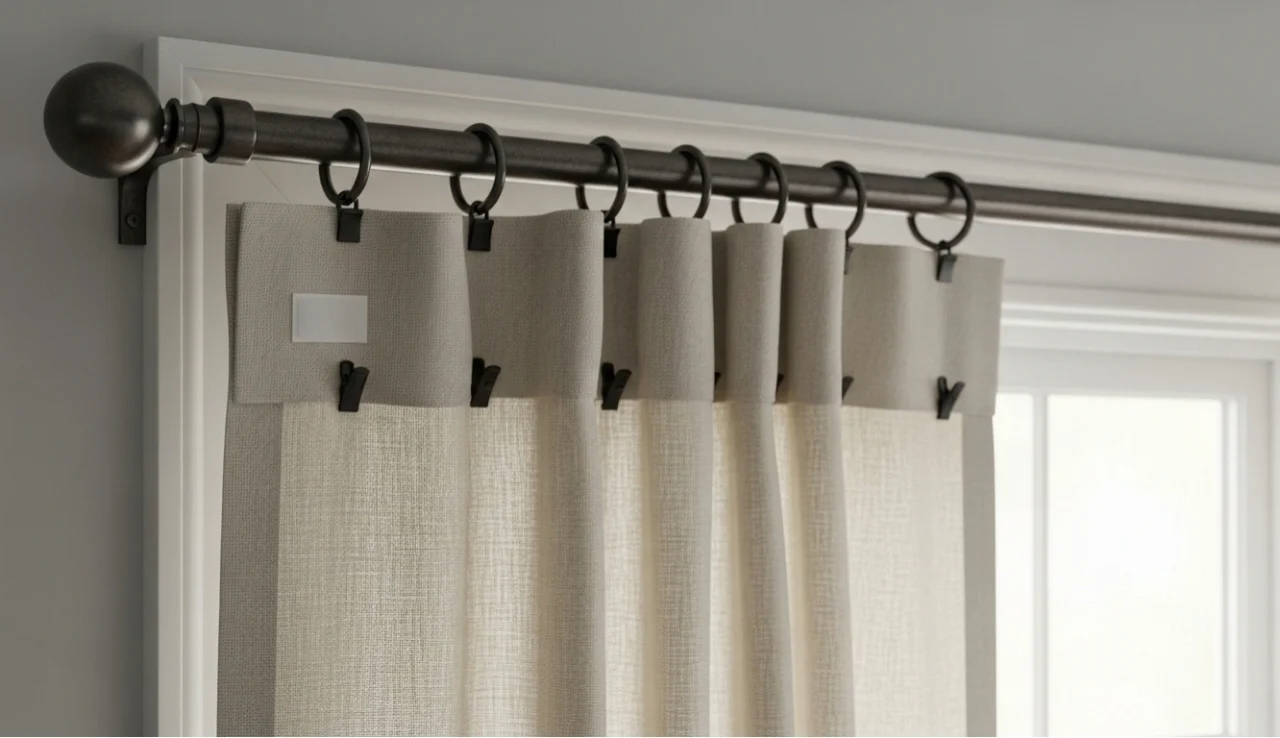
Instead of clipping the ring to the very top edge of your curtain, you clip it about one inch down from the top. The extra fabric above the clip folds forward and creates a small ruffle that hides the clip completely.
How to do it right:
- Clip each ring about 1 to 1.5 inches below the top edge of the curtain
- Use a ruler to mark the same distance on every clip point for consistency
- For perfect spacing, try the fold-in-half method place a clip at each end, fold the curtain in half, clip the center, and keep folding and clipping until all rings are evenly placed
The result looks almost identical to a rod pocket curtain, but you still get the easy sliding action of ring clips.
The Grosgrain Ribbon Method
Most guides don’t mention this one, and it’s honestly one of the best tricks out there. You sew or glue strips of grosgrain ribbon to the back of your curtain about 1.5 inches down from the top edge. Then you clip the rings onto the ribbon strips instead of the fabric edge.
Why it works so well:
- The clips grip the sturdy ribbon on the back side of the curtain
- Nothing is visible from the front
- You can space the ribbon pieces evenly so each clip lands in the perfect spot
- Works with fabric glue or iron-on adhesive — no sewing machine required
This method gives you the smooth sliding of ring clips with a completely clean front. It’s the best of both worlds.
Using Hidden Tab Tops
Hidden tab tops are fabric loops sewn to the back of the curtain header. They’re invisible from the front and slide directly onto the curtain rod, eliminating the need for ring clips entirely.
How to make them:
- Cut matching fabric strips about 4 inches wide and 8 inches long
- Fold each strip in half lengthwise, sew the edge, and turn it right side out
- Sew the ends to the back of your curtain’s top hem
- Space them 6 to 8 inches apart
This method works especially well for linen and cotton curtains. If you already own curtains with ring clips, you can retrofit hidden tabs by sewing strips of matching ribbon onto the back and threading the rod through them.
Positioning Clips Behind Pleats
If your curtains already have pinch pleats, box pleats, or goblet pleats, you have a built-in hiding spot. The pleats act as natural concealers for your ring clips.
Attach the clip to the back of each pleat where the fabric folds together. The pleat’s front face covers the clip completely. This is exactly how professional drapery installers do it.
Tips for best results:
- Use clips that match the color of your curtain rod
- For a standard 52-inch wide panel, 7 to 10 clips give you a beautiful even pleat pattern
- The more clips you use, the more defined your pleats will be
The Velcro Tab Concealment Trick
This method is perfect for renters or anyone who changes curtains frequently. Attach small Velcro strips to the back of your curtain panel at evenly spaced intervals and attach matching Velcro strips to the ring clips.
The Velcro holds the curtain firmly against the ring, and the attachment happens entirely on the back side of the fabric. Nothing shows from the front.
What to keep in mind:
- Best for lightweight to medium-weight fabrics
- Very heavy curtains might pull away from Velcro over time
- Makes removing and reattaching curtains incredibly easy for washing or seasonal changes
- Adhesive-backed Velcro strips cost just a couple of dollars at any hardware store
Switching to Drapery Pins Instead of Clips
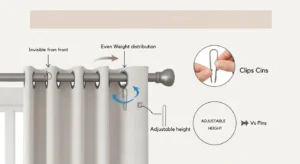
Most people don’t realize you can use your existing curtain rings without the clips. Drapery pins are small metal hooks with a sharp point on one end and a hook on the other. You slide the sharp end through the back of your curtain’s header and hook the other end onto the ring.
Why designers prefer drapery pins:
- Completely invisible from the front
- Distribute weight more evenly than clips
- Let you adjust curtain height by changing where you insert the pin
- Work especially well with lined and heavy curtains
- A pack costs just a few dollars on Amazon
This is actually the preferred method used by professional drapery workrooms and high-end interior design. It’s affordable and makes a huge difference.
Adding Decorative Trim or Ribbon
This method doesn’t just hide your clips it adds a design element. Attach a strip of decorative ribbon, trim, or contrasting fabric band along the top of your curtains to create a visual barrier that covers the clips entirely.
Options that work great:
- Grosgrain ribbon for a classic, tailored look
- Pom-pom or tassel trim for casual or bohemian spaces
- Curtain header tape for a stiff, structured European-style finish
- Contrasting fabric band to add color or pattern interest
You can use a hot glue gun for a quick fix or sew the trim on for durability. This approach is especially useful on solid-color curtains that could use a little extra visual interest at the top.
The Layer Curtain Technique
Very few guides mention this one, and it’s a favorite among interior designers. The idea is simple: hang a lightweight sheer curtain directly on the rod using rod pockets or grommets, then hang your main curtain behind the sheer layer using ring clips.
The sheer curtain acts as a decorative screen that completely conceals all the hardware behind it. From the front, all you see is beautiful flowing fabric.
Why it’s worth trying:
- Hides every piece of hardware completely
- Adds depth and richness to your windows
- Sheers let diffused light in during the day while heavier curtains provide privacy
- You can also drape elegant curtain scarves over the rod for a similar effect
- Requires a double curtain rod or two separate rods
This technique works beautifully in living rooms and bedrooms where you want both style and function.
Magnetic Clip Concealers
These are small fabric-covered magnetic pieces that snap over your existing ring clips. They hide the clip behind a clean, upholstered surface and come in various colors to match your curtains.
They’re easy to install — you literally just snap them on. They work best on lightweight to mid-weight curtains since very heavy drapes might cause them to shift.
Keep in mind:
- Not as widely available as other solutions
- Can add up in cost if you need many
- Perfect for renters who can’t make permanent changes
- Great for a fast, no-sew fix
Installing a Valance or Cornice Box
If you want to go all-in on hiding hardware, a valance or cornice box covers the entire rod, rings, clips, and all. A fabric valance is the softer option essentially a short curtain that hangs in front of your main curtain’s header. A cornice box is a structured, box-like frame covered in fabric or painted to match your walls.
Pros and cons:
- Cornice boxes give a polished, architectural feel and make windows look larger
- You can buy ready-made, order custom, or build your own from plywood and batting
- Valances and cornices add visual weight they can feel heavy in small rooms or spaces with low ceilings
- Best suited for formal living rooms, dining rooms, and master bedrooms
Switch to a Ceiling Mounted Track System
For a truly minimalist look, ditch ring clips and rods entirely in favor of a ceiling-mounted curtain track. These tracks are slim, often recessed into the ceiling, and completely invisible once curtains are hung.
Ceiling tracks use small gliders instead of ring clips. The result is a seamless line of fabric that drops straight from the ceiling popular in modern and Scandinavian-inspired interiors.
What you need to know:
- Requires a drill, anchors, and comfort with ceiling work
- Makes your ceilings feel taller since curtains run top to bottom without a visible break
- Provides the smoothest slide of all hanging methods
- Ideal for modern apartments and minimalist spaces
How to Train Your Curtains to Hold Their Shape
Hiding the clips is only half the battle. If your curtains don’t hold their pleats, the whole look falls apart. Training your curtains is the step most people skip, and it makes a dramatic difference.
Step-by-step training process:
- Steam your curtains from top to bottom once they’re hung using a handheld garment steamer
- Gently arrange each pleat by hand while the fabric is warm and pliable
- Loosely tie a strip of soft jute twine or ribbon around the curtains to hold the pleats in position
- Leave them tied for two to three days so the fabric “remembers” the shape
- Remove the ties the pleats should fall naturally into place
Heavier fabrics like velvet and lined linen respond especially well to training. Lighter fabrics like cotton may need a second round. Re-steam every few months to keep them looking fresh.
Final Thoughts
Hiding curtain ring clips is one of the easiest upgrades you can make to any room. Whether you choose the free fold-over trick, the grosgrain ribbon method, drapery pins, or a full ceiling-mounted track system the goal is the same. Let your curtains take center stage while the hardware disappears. Start with the method that fits your skill level and budget, train your curtains to hold their shape, and enjoy windows that look like a professional designed them. Your space deserves that polished finish.